
Proxmox HA-Cluster
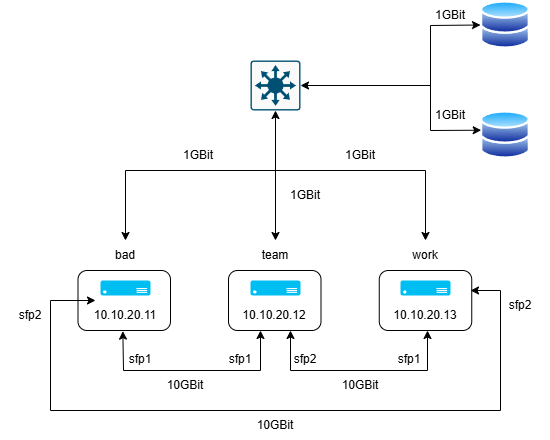
Anwendungen
- Cloudflare Tunnel
- Talescale
- Debian VM mit CasaOS und Teamspeak3 und Crafty Controller
- Windows Server VM
- Homepage
- Evtl. IP-Verwaltungsprogramm
- NGINX Proxy Manager (tisinti.com, tisinti.blog)
- 3 VMS (Ubuntu oder Debian) -> Ansible , Kubernetes -> Testumgebung evtl virtuelle LAN
- StirlingPDF
Eigenschaften
| pve1 | pve2 | pve3 | |
| Name | bad | team | work |
| IP-Adresse | 10.10.20.11 | 10.10.20.12 | 10.10.20.13 |
| Domain |
bad.gargano-home.net |
team.gargano-home.net |
work.gargano-home.net |
| Cloudflare-Tunnel | 10.10.20.14 | 10.10.20.15 | 10.10.20.16 |
| IP-Adress Vergabe | 10.10.20.21-64 | 10.10.20.65-128 |
10.10.20.129-196 |
| IPv6 für interne Kommunikation | fd69:beef:cafe::111/128 | fd69:beef:cafe::112/128 |
fd69:beef:cafe::113/128 |
OSPF Konfiguration mit ffr
Mit dieser Konfiguration wird für die Kommunikation zwischen den Nodes immer die Route mit den geringsten Kosten ausgewählt. In unserem Fall die 10GBit Verbindungen. Fällt einer diese aus, wird der der Traffik über eine weitere Node ausgewählt. Sollte diese ebenfalls ausfallen wird auf das normale 1GBit Netz zurückgergriffen. Es ist nicht erforderlich einen weiteren Switch einzubauen. Durch die eingebaut NICs ist die Konfiguration möglich.
Für jede Node wurde dabei eine IPv6-Adresse ausgewählt in unserem Fall:
Als OSPF Router-ID wurde Platzhaltermäßig die 0.1.1.1, 0.1.1.2 und 0.1.1.3 ausgewählt. Jede Node verfügt dabei über den virtuellen Anschluss vmbr0 und die zwei 10GBit NICs enp2s0f0np0 und enp2s0f1np1.
ffr Installation:
apt install frr -ynano /etc/frr/daemonsospf6d=yesnano /etc/frr/frr.confbad:
# Note:
# FRR's configuration shell, vtysh, dynamically edits the live, in-memory
# configuration while FRR is running. When instructed, vtysh will persist the
# live configuration to this file, overwriting its contents. If you want to
# avoid this, you can edit this file manually before starting FRR, or instruct
# vtysh to write configuration to a different file.
log syslog informational

#Enable IPv6 forwarding since we are using IPv6
ipv6 forwarding

#Add our router's private address on lo (loopback)
#This address is a single address (/128) out of the subnet (/64)
#of our 'cluster' network, of which routes to individial /128s are
#distributed using OSPF
!
interface lo
        ipv6 address fd69:beef:cafe::111/128
        ipv6 ospf6 area 0.0.0.0
        ipv6 ospf6 passive
#Backup links via primary gigabit link (vmbr0)
#Cost for 1G assumptions (100 gig reference / 1 gig = 100 cost)
!
interface vmbr0
        ipv6 ospf6 area 0.0.0.0
        ipv6 ospf6 network broadcast
        ipv6 ospf6 cost 100
#Two p2p links ens19 and ens20
#Since we are using IPv6 we do not need to assign
#addresses on these links, relying on link-local addresses
#Cost for 10G assumptions (100 gig reference / 10 gig = 10 cost)
#Feel free to edit your cost as appropriate
#You can tweak these cost values to change the traffic flow
!
interface enp2s0f0np0
        ipv6 ospf6 area 0.0.0.0
        ipv6 ospf6 network point-to-point
        ipv6 ospf6 cost 10
!
interface enp2s0f1np1
        ipv6 ospf6 area 0.0.0.0
        ipv6 ospf6 network point-to-point
        ipv6 ospf6 cost 10
#OSPF router settings (unique router ID required for each router)
!
router ospf6
        ospf6 router-id 0.1.1.1
        redistribute connected
        auto-cost reference-bandwidth 100000
team:
# Note:
# FRR's configuration shell, vtysh, dynamically edits the live, in-memory
# configuration while FRR is running. When instructed, vtysh will persist the
# live configuration to this file, overwriting its contents. If you want to
# avoid this, you can edit this file manually before starting FRR, or instruct
# vtysh to write configuration to a different file.
log syslog informational

#Enable IPv6 forwarding since we are using IPv6
ipv6 forwarding

#Add our router's private address on lo (loopback)
#This address is a single address (/128) out of the subnet (/64)
#of our 'cluster' network, of which routes to individial /128s are
#distributed using OSPF
!
interface lo
        ipv6 address fd69:beef:cafe::112/128
        ipv6 ospf6 area 0.0.0.0
        ipv6 ospf6 passive
#Backup links via primary gigabit link (vmbr0)
#Cost for 1G assumptions (100 gig reference / 1 gig = 100 cost)
!
interface vmbr0
        ipv6 ospf6 area 0.0.0.0
        ipv6 ospf6 network broadcast
        ipv6 ospf6 cost 100
#Two p2p links ens19 and ens20
#Since we are using IPv6 we do not need to assign
#addresses on these links, relying on link-local addresses
#Cost for 10G assumptions (100 gig reference / 10 gig = 10 cost)
#Feel free to edit your cost as appropriate
#You can tweak these cost values to change the traffic flow
!
interface enp2s0f0np0
        ipv6 ospf6 area 0.0.0.0
        ipv6 ospf6 network point-to-point
        ipv6 ospf6 cost 10
!
interface enp2s0f1np1
        ipv6 ospf6 area 0.0.0.0
        ipv6 ospf6 network point-to-point
        ipv6 ospf6 cost 10
#OSPF router settings (unique router ID required for each router)
!
router ospf6
        ospf6 router-id 0.1.1.2
        redistribute connected
        auto-cost reference-bandwidth 100000
work:
# Note:
# FRR's configuration shell, vtysh, dynamically edits the live, in-memory
# configuration while FRR is running. When instructed, vtysh will persist the
# live configuration to this file, overwriting its contents. If you want to
# avoid this, you can edit this file manually before starting FRR, or instruct
# vtysh to write configuration to a different file.
log syslog informational

#Enable IPv6 forwarding since we are using IPv6
ipv6 forwarding

#Add our router's private address on lo (loopback)
#This address is a single address (/128) out of the subnet (/64)
#of our 'cluster' network, of which routes to individial /128s are
#distributed using OSPF
!
interface lo
        ipv6 address fd69:beef:cafe::113/128
        ipv6 ospf6 area 0.0.0.0
        ipv6 ospf6 passive
#Backup links via primary gigabit link (vmbr0)
#Cost for 1G assumptions (100 gig reference / 1 gig = 100 cost)
!
interface vmbr0
        ipv6 ospf6 area 0.0.0.0
        ipv6 ospf6 network broadcast
        ipv6 ospf6 cost 100
#Two p2p links ens19 and ens20
#Since we are using IPv6 we do not need to assign
#addresses on these links, relying on link-local addresses
#Cost for 10G assumptions (100 gig reference / 10 gig = 10 cost)
#Feel free to edit your cost as appropriate
#You can tweak these cost values to change the traffic flow
!
interface enp2s0f0np0
        ipv6 ospf6 area 0.0.0.0
        ipv6 ospf6 network point-to-point
        ipv6 ospf6 cost 10
!
interface enp2s0f1np1
        ipv6 ospf6 area 0.0.0.0
        ipv6 ospf6 network point-to-point
        ipv6 ospf6 cost 10
#OSPF router settings (unique router ID required for each router)
!
router ospf6
        ospf6 router-id 0.1.1.3
        redistribute connected
        auto-cost reference-bandwidth 100000
Test connection with iperf3
Installation:
apt install iperf3Start:
iperf3 -sNload:
apt-get install nloadnload vmbr0 enp2s0f0np0 enp2s0f1np1iperf3 -c fd69:beef:cafe::111 -t 3000iperf3 -c fd69:beef:cafe::112 -t 3000iperf3 -c fd69:beef:cafe::113 -t 3000apt-get remove nloadDeinstallieren:
apt-get remove iperf3